Friday, July 20, 2018

Shares of eBay drop 9 percent after weak growth, lowered revenue forecast

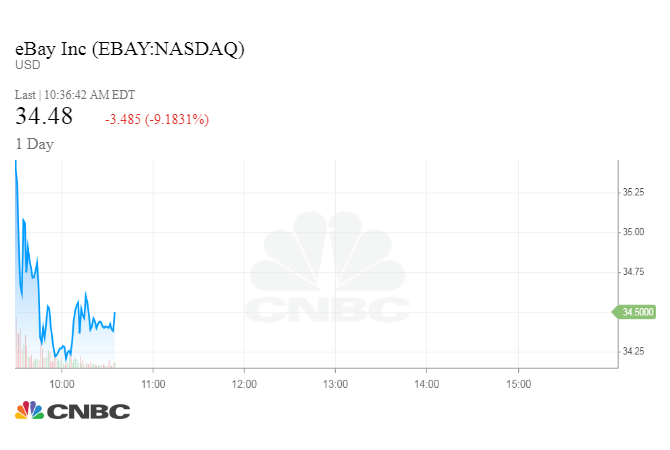
Shares of eBay fell 9 percent in trading Thursday after the company reported sluggish growth in its marketplace business and lowered its revenue forecast for the the rest of the year.

The online marketplace reported second-quarter earnings of 53 cents per share, while revenue came in at $10 billion. While the earnings were 2 cents per share above what analysts surveyed by Thomson Reuters anticipated, eBay's revenue came in $50 million short of expectations. In addition, eBay adjusted its full year revenue forecast, lowering its estimate to a range of $10.75 billion to $10.85 billion from its previous estimate of $10.9 billion to $11.1 billion.

"Marketplace initiatives ... are ramping slower than expected and likely shifts potential acceleration to 2019," Raymond James analysts wrote in a note to investors, also noting that growth in eBay's subsidiary StubHub "is likely to remain challenging near-term."

StubHub's quarterly performance missed Credit Suisse's expectation as well. The firm said in a note that StubHub's lackluster result was "due to a poor events environment."

"We expect eBay shares to revisit recent lows, as the headwinds in StubHub was an unexpected development," Credit Suisse said.

Shares of eBay were nearly flat for the year before its second-quarter earnings report, up 0.6 percent at $37.95 per share as of Wednesday's close.

Thursday, July 19, 2018

What's Behind RH's 450% Run?

High-end furniture maker RH (NYSE:RH)�-- formerly Restoration Hardware -- continues to defy skeptics. The company's most recent earnings report propelled the stock higher by more than 30% in a single day. Since hitting a low in February 2017, shares are up a whopping 450% as of this writing.

It has been easy to make a bearish case against RH in recent years considering a challenging brick-and-mortar retail environment and the company's burdensome debt. But short-sellers look woefully unstylish at the moment. Here are three reasons this stock is soaring.

RH Chart

RH data by YCharts.�

1. The business is humming along

First off, RH is getting things done at an operational level. It is successfully selling high-end furnishings both in stores and online -- what's called an "omnichannel" strategy in the retail world. In 2017, for example, transactions in stores accounted for 56% of total sales, and the remainder were from "direct business" through its catalog and website.

This balanced approach is critical to compete with purely online, low-cost heavyweights like Amazon.com and Wayfair in the furnishings space. Customers searching for sofas that cost thousands of dollars want to see and feel the product in person, but they also want to be able to customize their exact purchase through an easy-to-use website. RH has done an enviable job of meeting their needs.

An added benefit is that optimizing for a specific sales channel has not consumed the company's salesforce. Instead, CEO Gary G. Friedman has emphasized a product-first strategy, with the various channels -- brick-and-mortar, online, and catalog -- being equally capable of facilitating and closing the sales of those products. This is described in the company's 2017 annual report as follows: "We encourage our customers to shop across our channels and have aligned our business and internal organization to be channel agnostic."

Two things are particularly impressive about RH's channel shift: (1) The company has prevented cannibalization such that sales have continued to grow at a steady clip over the last eight years and�(2) the transition has not created excessive marketing and administrative expenses as RH dialed in its omnichannel approach.

The following chart shows why the market's impressed with RH's recent sales and marketing accomplishments. In eight years, sales have grown 290% versus a comparably slower increase in sales, general, and administrative expenses of 200%.
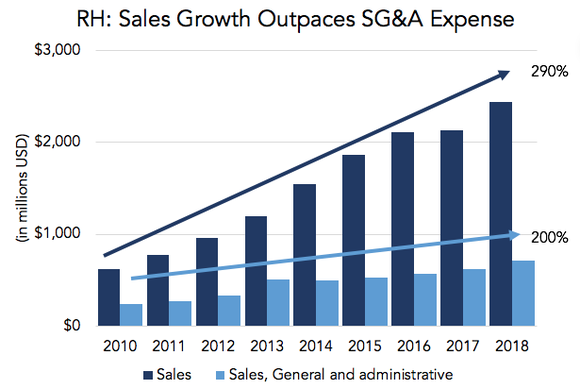
A bar chart showing sales and expense growth

Data source: Morningstar data, author's calculations.

Overall, this trend has been a significant contributor to the recent quarterly earnings surprises (see here, here, and here), and is illustrative of the operational execution that has propelled RH's stock price higher.

2. The company is heavily buying back shares

The second factor contributing to RH's rapidly growing stock price is a string of share buybacks executed by the company. These share repurchases are nothing to sneeze at: More than $1 billion of the company's capital has been dedicated to buying shares off the open market, which has led to a 40% reduction of shares outstanding since the fourth quarter of 2016.

The following chart shows the decline in outstanding stock, with the largest reduction taking place in 2017 when a $300 million and $700 million buyback were proposed, approved by the board, and executed:
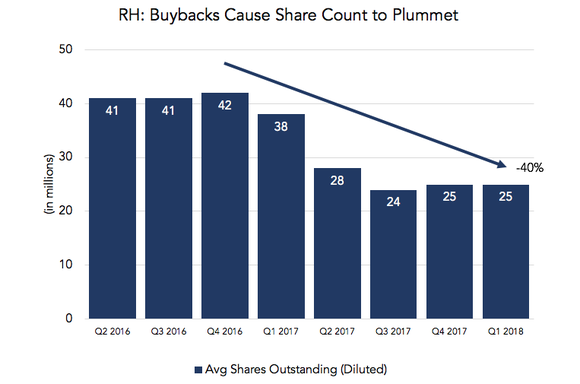
A bar chart showing share count decline

Data source: Morningstar data, author's calculations.

With share buybacks, companies typically use excess cash on their balance sheets to "retire" shares, ideally at a point in time where leadership sees the company's stock as undervalued by the market. A share repurchase doesn't change the market capitalization of the company by itself, but it does entitle the remaining common shareholders to a bigger slice of the earnings pie. As a result, this can send the stock higher, as has been the case for RH.

RH's share repurchases look extremely savvy in retrospect, given the stock has soared since their execution. However, there are some legitimate reasons to question this move, especially considering the fact that RH is not sitting on a pile of cash and instead raised debt to effect the share repurchase. Discussing the merits of RH's share repurchase is a debate for another article, however, and it's a topic that's been well-covered by my Foolish colleague Brian Stoffel. As he points out, there are perfectly valid reasons to be skeptical of the CEO's incentives for propelling RH's stock price higher through leveraged share buybacks.

Despite the risk of added debt, the share repurchases have propelled the stock higher by boosting quarterly earnings per share, and they've also had an effect on the company's unique short-seller situation. This brings us to our final -- and perhaps most important -- driver of RH's recent share price run-up.

3. The short-sellers are getting squeezed big-time

The third reason RH's stock price has ballooned is due to a unique "short-squeeze" situation. A short-squeeze involves investors betting against a stock by borrowing shares in the expectation that the stock price will decrease in the future. If the stock price does not decrease, those short-sellers are in a losing position because they must purchase the shares at a higher price to return the ones they borrowed.

This is not only happening with RH's stock, but it's happening on an exaggerated level . RH, as a risky, debt-laden participant in the declining brick-and-mortar retail industry, has found itself heavily shorted, to the point where more than 60% of its shares outstanding were sold short in the middle of 2017. In the past two years, the average percent of shares outstanding short at RH has hovered around 35%, which is roughly where it stands today. Here's a look at that trend and how it compares at retail peers Williams-Sonoma�and The TJX Companies.

RH Percent of Shares Outstanding Short Chart

RH Percent of Shares Outstanding Short data by YCharts.

As you can see, there's a greater proportion of short-sellers tied to RH than to its peers. Investors are betting against RH's future in hopes that it will underperform. Ironically, as the opposite happens -- i.e., when RH posts better operational results (see point No. 1 above) and buys back shares (see No. 2 above) -- these catalysts push the stock higher and force short-sellers to decide whether they want to ride out their bet longer or close their position. If they do the latter, they must buy shares in the company to do so, which in turn pushes the stock even higher.There is a compounding effect at work here, and it doesn't end there. With RH, there aren't hundreds of millions of shares outstanding. There are roughly 25 million at RH, compared to 625 million at The TJX Companies. This is called a small "float." This can lead to a scarcity of sellers when the shorts need trading to take place, which can in turn force them to bid the price even higher. What ends up happening is an "infinity squeeze" is created when the unusual shortage of supply rockets a share price upward.It is one thing to see a stock price grow on strong earnings, but quite another for those results to be inflated by share repurchases and propelled beyond logic by the peculiar machinations of an infinity short squeeze. But this is what's happening at RH.

The takeaway for investors

With a track record of 450% stock price growth in less than two years, it's not surprising to see that there's something unusual happening here at RH, something that goes beyond the fundamentals of the business.

Yes, the company is performing well and adapting to change in the retail world, but it has also benefited from some risky bets where a large sum of debt was used to repurchase its own stock. Beyond that, it's seen external factors -- a high percentage of short-sellers -- contribute to the stock's meteoric rise as they get squeezed out of their position. RH has an impressive tailwind, but it's definitely not a stock for the faint of heart right now.
Friday, July 13, 2018

FY2020 EPS Estimates for Arch Coal Inc Increased by Jefferies Financial Group (ARCH)

Arch Coal Inc (NYSE:ARCH) – Equities research analysts at Jefferies Financial Group increased their FY2020 earnings per share (EPS) estimates for shares of Arch Coal in a research note issued on Monday, July 9th. Jefferies Financial Group analyst C. Lafemina now anticipates that the energy company will post earnings per share of $8.83 for the year, up from their previous estimate of $8.82.

Get Arch Coal alerts:

Arch Coal (NYSE:ARCH) last posted its earnings results on Thursday, April 26th. The energy company reported $2.95 earnings per share for the quarter, missing the Zacks’ consensus estimate of $4.30 by ($1.35). The firm had revenue of $575.30 million for the quarter, compared to the consensus estimate of $594.04 million. Arch Coal had a return on equity of 39.10% and a net margin of 10.73%. The business’s revenue was down 4.3% on a year-over-year basis. During the same period last year, the company posted $2.55 EPS.

ARCH has been the topic of a number of other research reports. Seaport Global Securities set a $112.00 price target on shares of Arch Coal and gave the stock a “buy” rating in a report on Monday, April 23rd. Zacks Investment Research lowered shares of Arch Coal from a “strong-buy” rating to a “hold” rating in a report on Tuesday, April 17th. ValuEngine lowered shares of Arch Coal from a “buy” rating to a “hold” rating in a report on Monday, April 2nd. MKM Partners set a $106.00 price target on shares of Arch Coal and gave the stock a “buy” rating in a report on Wednesday, June 6th. Finally, B. Riley decreased their price target on shares of Arch Coal from $115.00 to $97.00 and set a “buy” rating on the stock in a report on Friday, April 27th. Five analysts have rated the stock with a hold rating and six have given a buy rating to the company’s stock. The stock currently has an average rating of “Buy” and an average target price of $97.89.

Arch Coal opened at $77.24 on Tuesday, Marketbeat reports. The company has a debt-to-equity ratio of 0.45, a quick ratio of 2.41 and a current ratio of 2.89. The company has a market cap of $1.66 billion, a P/E ratio of 6.80 and a beta of 0.07. Arch Coal has a 1-year low of $68.95 and a 1-year high of $102.61.

The business also recently declared a quarterly dividend, which was paid on Friday, June 15th. Stockholders of record on Thursday, May 31st were issued a $0.40 dividend. This represents a $1.60 dividend on an annualized basis and a dividend yield of 2.07%. The ex-dividend date was Wednesday, May 30th. Arch Coal’s payout ratio is 14.08%.

Several large investors have recently modified their holdings of ARCH. Envestnet Asset Management Inc. increased its holdings in shares of Arch Coal by 100.1% in the 4th quarter. Envestnet Asset Management Inc. now owns 1,449 shares of the energy company’s stock worth $135,000 after buying an additional 725 shares during the last quarter. Jefferies Group LLC bought a new position in shares of Arch Coal during the 4th quarter valued at $224,000. Amalgamated Bank bought a new position in shares of Arch Coal during the 4th quarter valued at $226,000. Oppenheimer Asset Management Inc. bought a new position in shares of Arch Coal during the 1st quarter valued at $232,000. Finally, Sei Investments Co. grew its holdings in shares of Arch Coal by 3,230.4% during the 1st quarter. Sei Investments Co. now owns 2,631 shares of the energy company’s stock valued at $242,000 after purchasing an additional 2,552 shares during the last quarter. 92.61% of the stock is currently owned by hedge funds and other institutional investors.

Arch Coal Company Profile

Arch Coal, Inc produces and sells thermal and metallurgical coal from surface and underground mines. As of December 31, 2017, the company operated 9 active mines located in Wyoming, West Virginia, Kentucky, Virginia, Colorado, and Illinois. It also owned or controlled, primarily through long-term leases, approximately 28,292 acres of coal land in Ohio; 1,060 acres of coal land in Maryland; 10,108 acres of coal land in Virginia; 359,160 acres of coal land in West Virginia; 98,488 acres of coal land in Wyoming; 267,857 acres of coal land in Illinois; 34,446 acres of coal land in Kentucky; 9,840 acres of coal land in Montana; 21,802 acres of coal land in New Mexico; 358 acres of coal land in Pennsylvania; and 20,165 acres of coal land in Colorado, as well as owned or controlled through long-term leases smaller parcels of property in Alabama, Indiana, Washington, Arkansas, California, Utah, and Texas.

Earnings History and Estimates for Arch Coal (NYSE:ARCH)

Thursday, July 12, 2018

Why Corporate America is recruiting high schoolers

With more job openings than unemployed workers in the US economy, companies are finding it hard to fill jobs.

One solution is for corporations to train high school students with the skills needed in the labor market. Sometimes, they start as young as kindergarten.

Since 2011, more than 400 companies have partnered with 79 public high schools across the country to offer a six-year program called P-Tech. Students can enroll for grades 9 to 14 and earn both a high school and an associate's degree in a science, tech, engineering or math related field.

The companies offer input on the curriculum, bring students on site, pair them with employee mentors, and offer paid internships, or some combination of the above.

"There's a war for talent across all our competitors. We know we're going to need a lot of different pathways to bring talent in," said Jennifer Ryan Crozier, president of the IBM Foundation.

IBM was the first to try out the P-Tech model, working with a high school in Brooklyn and the City University of New York.

Since then, energy companies National Grid and Con Edison have partnered with another school in New York City, as has Montefiore Medical Center. Both Motorola and Verizon work with schools in Chicago and Dow Chemical will start working with a new program in Louisiana in the fall �� to name a few.

Connecticut, Maryland, Rhode Island, Colorado, and Texas also have P-Tech schools, and state funding has been set aside to open some in California in 2019.

P-tech schools are a modern version of what were once commonly known as vocational schools. But unlike those of the past, which sometimes became a "dumping ground for less-academic kids," newer career and technical programs are careful not to close off a pathway to college, said Brian Jacob, a professor of education policy and economics at the University of Michigan.

Instead, they aim to prepare students for both a career and higher education.

In fact, a majority of P-Tech's early graduates have chosen to pursue a bachelor's degree rather than jump immediately into the workforce.

Employers know they are playing the long game.

"This is about preparing the next generation of the workforce," Crozier said. "It's not a short-term fix for roles we have open today," she said.

ibm ptech IBM mentors work with P-Tech engineering students.

Many employers expect the skills gap to get worse if nothing is done.

"About five years ago, we took a look at the future gap in the workforce and decided that we need to do even more," said Ken Daly, COO at National Grid, which delivers energy to New York, Massachusetts, and Rhode Island.

Not only is the industry's workforce aging, but there will be an increase in the number of new energy jobs created, he said. Plus, he doesn't believe today's students have as much of an interest in STEM (science, technology, engineering, math) subjects as they did in the past. He's working to change that.

National Grid partnered with a P-Tech school in Queens in 2013. Its students visit National Grid's offices, one of its electric power plants, and a gas control center. Employees come to class to teach them how to fuse a gas pipe and splice a cable.

National Grid works with community colleges, middle schools and elementary schools, too. Daly recently visited a kindergarten class.

"We really believe that if we start young, we can create this pipeline of students who see a career in energy," he said.

ibm ptech janiel richards P-Tech graduate Janiel Richards meets with IBM CEO Ginni Rometty.
In 2016, Janiel Richards was one of the first to graduate from a P-Tech program. She earned an associate's degree in computer information systems and interned at IBM and CUNY during the summers.

Richards, now 20, was offered a job at IBM within two months of graduating. She currently works full-time there as a visual designer while also working toward a bachelor's degree in graphic communication at Baruch College in Manhattan.

"I really wanted to continue my education, but I also wanted to continue what I had going with IBM because I had such a strong network," Richards said.

P-Tech taught her coding and development, but she values the soft skills she learned there just as much. Good time management and open communication with her manager at work make it possible for her to handle the busy schedule.

"I've learned how to handle myself in the workplace, how to get my point across, and how to write an email to people like Ginni," she said, referencing IBM CEO Ginni Rometty.

It was her mom that encouraged her to enroll in P-Tech. Now that she has earned her associate's degree at no cost and launched her career at IBM, Richards helps support her mom and four younger sisters financially.

Wednesday, July 11, 2018

Match Group Update: Tinder Gold Is Getting Even Shinier

The last month has been a busy one for Match Group (MTCH). On June 20, the company announced that it had acquired a controlling stake in Hinge, a dating app that previously competed with Tinder. The fast-growing Hinge joins Match Group's large portfolio of dating sites and apps, including Tinder, OkCupid, Match.com, and PlentyofFish.

But even more importantly, the company also introduced several new features for its cash cow Tinder app, with several more currently in the works. Here I review why these developments add significant value to Match Group's services and make the company's stock an even more compelling buy.

The 'Gold' In Tinder Gold

The 2012 launch of Tinder marked a seminal shift in the mechanics of online dating. With its rapid-fire "swipe" feature and double opt-in system, the app brought digital matchmaking into the mobile age and spurred a massive shift in societal attitudes toward online dating.

Ever since then, Match Group and Tinder's managers have demonstrated what Sam Walton called a "bias toward action." The company successfully monetized its free app by introducing an optional premium service called "Plus" in 2015. The upgrade includes features such as unlimited daily swiping and the ability to "passport" to any location in the world.

The launch of "Gold" in 2017 also proved an enormous success, allowing users to bypass the swipe system and directly view profiles of people who have already "swiped right" (that is, indicated interest). A brilliant (and ongoing) marketing campaign tempts users with this knowledge by blurring out the results, which are only viewable once they pay for a Gold subscription.

Adding Value

Recent developments show that Tinder is not resting on its laurels, continuing to add value to its Tinder Gold service and the app in general. Last month, the company launched Tinder Picks, a new feature available exclusively for Tinder Gold subscribers. Picks, which mimics rival app Coffee Meets Bagel, presents users with four profiles daily based on factors such as education, interests, and swipe history.

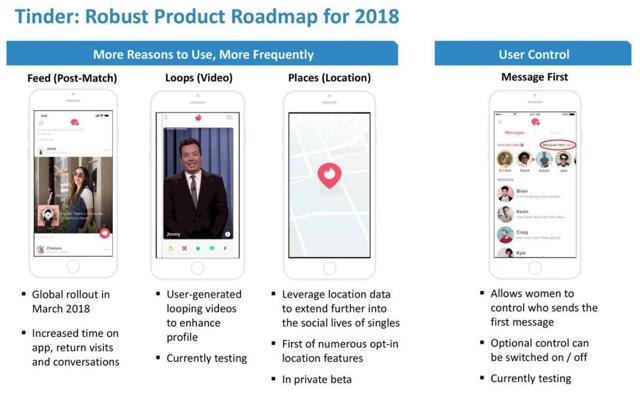
On July 5, Tinder also rolled out its Loops feature, which it had previously tested in Canada and Sweden, to its global user base. Loops allows users to post two-second, looping videos to their profiles in lieu of a static photograph.

The Q1 earnings call also revealed that the company is testing a "Places" feature, which allows users to see potential matches who frequent similar bars, shops, and other locations. Places is consistent with Tinder's overall strategy to increase user engagement. According to CEO Mandy Ginsburg, the early testing shows that half of users who open Tinder use Places daily. In an effort to take on rival app Bumble, Tinder is also working on an optional feature that allows women to message first.

source: 2018 Q1 Earnings Call Slideshow

Evidence From Financial Results

Although Match Group does not break down results by site, the most recent earnings call provides evidence of the success attributable to Tinder Gold. Gold proved critical to the company's earnings surge in late 2017, and the results since then suggest that Tinder's paid services are "sticky" with its user base.

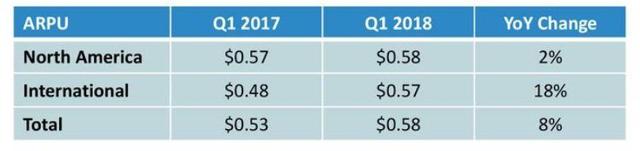
In Q1 of 2018, Tinder added 368,000 subscribers and delivered its best average revenue per user (ARPU) growth in two years. According to Match CFO Gary Swindler, Tinder's ARPU in Q1 grew 37 percent year-over-year. The company's ARPU as a whole reached $0.58 in Q1 - well above the $0.53 that it achieved in 2017. This growth confirms the company's pricing power, which I discussed in prior articles.

source: 2018 Q1 Earnings Call Slideshow

Unlike other recent Internet IPOs, marketing spend as a percentage of revenue fell sharply in Q1 compared to the same period in 2017. Sales and marketing expenditure rose $11 million year-over-year, and the category now takes up 29 percent of sales compared to 36 percent last year. Match Group's portfolio of sites benefits from strong brands that require little advertising due to word-of-mouth exposure.

With such fantastic economics and a sticky user base, Match Group is significantly undervalued as a company. Yet, shares remain depressed amid negative sentiment surrounding Facebook's (FB) entry into online dating. As I discuss in my May 3 article, the social media giant's move is of little relevance to Match Group's business.

Even though Match crushed its most recent quarter, Wall Street still reacted with a collective shrug. Because of that, the company's valuation is now down to 28 times earnings per share. Given the company's solid fundamentals, this price presents a compelling opportunity to pick up more shares.

Disclosure: I am/we are long MTCH.

I wrote this article myself, and it expresses my own opinions. I am not receiving compensation for it (other than from Seeking Alpha). I have no business relationship with any company whose stock is mentioned in this article.

Tuesday, July 10, 2018

Analysts Set Foxtons Group PLC (FOXT) PT at $76.50

Shares of Foxtons Group PLC (LON:FOXT) have earned an average recommendation of “Hold” from the six analysts that are currently covering the stock, Marketbeat Ratings reports. Three analysts have rated the stock with a sell rating, two have given a hold rating and one has given a buy rating to the company. The average 12 month price objective among analysts that have updated their coverage on the stock in the last year is GBX 76.50 ($1.02).

A number of research analysts have recently issued reports on FOXT shares. Barclays dropped their price target on shares of Foxtons Group from GBX 66 ($0.88) to GBX 52 ($0.69) and set an “underweight” rating on the stock in a research report on Tuesday, March 20th. Peel Hunt boosted their price target on shares of Foxtons Group from GBX 55 ($0.73) to GBX 60 ($0.80) and gave the stock a “sell” rating in a research report on Thursday, April 19th. Numis Securities restated a “buy” rating and issued a GBX 123 ($1.64) price target on shares of Foxtons Group in a research report on Thursday, May 17th. Credit Suisse Group dropped their price target on shares of Foxtons Group from GBX 69 ($0.92) to GBX 56 ($0.75) and set a “neutral” rating on the stock in a research report on Thursday, May 17th. Finally, Citigroup dropped their price target on shares of Foxtons Group from GBX 80 ($1.07) to GBX 75 ($1.00) and set a “neutral” rating on the stock in a research report on Monday, May 21st.

FOXT stock opened at GBX 49.95 ($0.67) on Friday. Foxtons Group has a 1 year low of GBX 63.50 ($0.85) and a 1 year high of GBX 115.13 ($1.53).

Foxtons Group Company Profile

Foxtons Group plc, an estate agency, provides residential property sales and lettings services in the United Kingdom. It operates through three segments: Sales, Lettings, and Mortgage Broking. The company is involved in short letting and corporate letting; and the provision of property management services.

Analyst Recommendations for Foxtons Group (LON:FOXT)

Friday, July 6, 2018

Friday’s Biggest Winners and Losers in the S&P 500

July 6, 2018: The S&P 500 closed up 0.8% at 2,759.68. The DJIA closed up 0.4% at 24,451.23. Separately, the Nasdaq was up 1.3% at 7,688.39.

Friday was a positive day for the broad U.S. markets, closing out an ultimately positive but shortened week. Crude oil bounced back on the day. The S&P 500 sectors were entirely positive. The most positive sectors were technology, health care, and consumer discretionary, up 1.3%, 1.6%, and 0.9%, respectively. The ��worst�� performing sector was real estate up 0.4%.

Crude oil was last seen trading up 1.2% at $73.81.

Gold was last seen trading down 0.2% at $1,256.30.

The stock posting the largest daily percentage loss in the S&P 500 ahead of the close was Cboe Global Markets, Inc. (NASDAQ: CBOE) which fell about 2% to $100.79. The stock��s 52-week range is $91.12 to $138.54. Volume was nearly 1 million compared to the daily average volume of 1.1 million.

The S&P 500 stock posting the largest daily percentage gain ahead of the close was Biogen Inc. (NASDAQ: BIIB) which traded up about 19% at $355.17. The stock��s 52-week range is $249.17 to $370.57. Volume was over 12 million compared to the daily average volume of 1.6 million.


Thursday, July 5, 2018

CEO of LaCroix maker sued for unwanted touching

The CEO of the company behind LaCroix sparkling water has been sued by two former pilots who say the company's top executive subjected them to unwanted sexual touching on multiple occasions.

The two male pilots filed separate lawsuits in Florida against Nicholas Caporella, the 82-year-old CEO of Corporate Management Advisors Inc. Caporella's company operates National Beverage Corp., which makes LaCroix.

Caporella is also an experienced pilot who flies the company's jet out of Fort Lauderdale. The co-pilots were in the cockpit with him during the alleged incidents, according to court documents.

National Beverage (FIZZ) and lawyers representing Caporella did not immediately return messages from CNNMoney seeking comment. The Wall Street Journal, which was first to report the lawsuits, said Caporella's attorney Glenn Waldman called the claims false and "scurrilous."

One lawsuit, filed in 2016, claimed that Caporella engaged in a "repeated pattern of unprovoked and unwanted sexual touching." He would allegedly grab the pilot's leg and "commence moving his hand up Plaintiff's left thigh, towards his genitals."

That suit, brought against Caporella and National Beverage by Terence Huenefeld and his wife, Paula Huenefeld, sought damages for a hostile work environment, abuse and sexual battery.

The lawsuit says Caporella's alleged behavior happened on 18 separate occasions and when Huenefeld complained he was told by his superior that he must allow and "put up with it."

That case was settled earlier this year for an undisclosed amount, according to Nnamdi Jackson, an attorney for the two pilots.

The second case, which alleges similar behavior, was filed in January 2017 against National Beverage, Caporella and Broad River Aviation Inc., which operates the jet used for National Beverage's business trips. Pilot Vincent Citrullo says in the suit he was treated like an employee of National Beverage and not a contractor. Broad River did not respond to a request for comment.

#MeToo and #TimesUp have pushed 48% of companies to review pay policies

On 14 occasions between 2014 and 2015, Citrullo says he was subjected to a pattern of "unprovoked and unwanted sexually oriented touching."

He also claims a violation of labor laws, saying he was required to work 83 weekend days and nights without compensation. He also says he was not paid proper overtime wages as required by law.

That case is still pending, according to court documents and Jackson.

National Beverage (FIZZ) has a market value of $5 billion. It found recent success as LaCroix took off as a healthier alternative to sugary sodas.

Wednesday, July 4, 2018

Wells Fargo Clawing Its Way Back

Wells Fargo (WFC) has shown that it can self-inflict wounds on a level that��s hard to match among the largest U.S. banks. While Wells Fargo is well and truly hated by quite a few people now (including investors), management has been working to rebuild the bank on multiple levels, including employee compensation/incentives, training, compliance, and customer relations. Rebuilding the brand and reputation is going to take a lot longer, and the bank still has serious regulatory headwinds, but the underlying operations haven��t been damaged all that badly.

Wells Fargo looks undervalued, but then so do others like Citigroup (C) and U.S. Bancorp (USB) (both with their own issues/challenges), as well as JPMorgan (JPM) and PNC (PNC). I won��t make a forceful argument that Wells Fargo is a must-own at today��s price, but the long-term potential total returns look pretty interesting and this remains a massive national platform with a very strong retail deposit base.

Feeling Less Stress From The Feds

Wells Fargo is likely going to be operating under the asset cap it agreed to as part of a consent decree earlier this year until at least mid-2019, but that doesn��t mean the bank��s regulators are necessarily stepping on the bank��s throat. Wells Fargo not only passed its stress test, but the company got approval for a substantial increase in its capital returns to shareholders �� seeing as how compliance issues are part of the process, I would argue that this can be seen as at least partial affirmation by the regulators that Wells Fargo is making progress with its compliance remediation issues.

Wells Fargo is likely going to pay out more than 100% of its earnings in buybacks and dividends this year. Not only did the bank get approval for a large year-over-year increase in its buyback authorization, but at $24.5 billion, Wells Fargo��s buyback authorization is quite a bit larger than peers like JPMorgan ($20.7 billion) and Bank of America (BAC) ($20.6 billion). Keep in mind that with the asset cap in place, there are limits to how much Wells Fargo can grow, so I wouldn��t exactly get used to this level of capital return, but it is a positive development all the same.

I��d also note the company��s decision to sell 52 branches to Flagstar (FBC) for a 7% deposit premium. Regulators could have stopped this transaction dead if they��d wanted to, and instead Wells Fargo is being allowed to profitably dispose of branches it didn��t really need or want anyway.

Improving Trends, But Wells Fargo Is Hamstrung

It was just as well that Wells Fargo had lackluster loan and deposit growth in the first quarter (loans down 2% on an end-of-period basis), while JPMorgan and PNC saw 4% loan growth and U.S. Bancorp saw 2% - with the cap in place, significant growth will create some balance sheet management challenges for Wells Fargo management.

Even so, there are positive underlying trends for the bank. Wells Fargo never lost as many customers or employees as many seemed to expect when the scandals were erupting. Customer growth/attrition bottomed out around the third quarter of 2017 and the bank has gone back to seeing growth in its retail and small business customer numbers.

There are also improving underlying trends in the banking sector as a whole. Fed data shows a 5% year-over-year growth rate for loans in the second quarter, with 1.4% sequential growth. Both CRE and C&I categories grew about 5% in the quarter, and card loans were up an eye-popping 9%. Deposit growth didn��t quite keep up (up 3.5% yoy), but that��s not so surprising. While smaller banks are seeing stronger growth, the large bank subdivision isn��t doing bad at all, with loan growth of more than 2% (despite a year-over-year decline in CRE lending) and deposit growth of about 3%.

I find it interesting that large banks are outperforming on deposit growth. That could put a little more pressure on smaller bank balance sheets, as these banks often have higher loan/deposit ratios and will need to pay more to fund the loan growth they��re seeing in areas like CRE lending. Along these lines, I��d also note that Wells Fargo��s deposit betas have remained pretty healthy on both an absolute and relative basis, with a cumulative beta below 30% since this rate cycle began.

The Opportunity

Wells Fargo made a pretty good case during its May Investor Day for improving returns on equity in the coming years, as the bank intends to close or sell almost 20% of its branches, while continue to leverage IT investments to reduce costs and attract/retain customers. With that, management is targeting some meaningful expense reductions �� more than 7% from 2017 to 2020. Although credit costs should increase (the bank is at around half of management��s estimate for full-cycle charge-off ratios), management has been shifting the loan composition toward a less risky mix (lower auto, lower pick-a-pay, lower junior lien mortgages).

At this point, a prolonged period of regulatory headwinds is probably the biggest company-specific risk facing Wells Fargo. While the asset cap could be lifted in mid-2019, other banks (including M&T Bank (MTB) and U.S. Bancorp) have seen regulatory/compliance issues drag on longer than expected and a prolonged cap on balance sheet growth would certainly make it harder for the bank to generate earnings growth.

My basic outlook for Wells Fargo remains basically unchanged, though, as I expect long-term growth in the mid-single digits. That supports a healthy return today and a fair value around $60, as does the near-term outlook for ROTE (ROTE and P/TBV tend to be pretty closely correlated).

The Bottom Line

I��m sure I��ll hear from readers proclaiming that Wells Fargo��s management team should all be in jail and how they��d never even consider owning the shares. So be it �� buy and hold whatever it is you��re comfortable with, and if Wells Fargo��s actions are unforgivable to you, I certainly won��t second-guess your decision. For the rest, though, I think the valuation on Wells Fargo is interesting enough to consider, though it��s not so special that there aren��t other options in the big-bank space that look almost as good (if not better).

Disclosure: I am/we are long JPM.

I wrote this article myself, and it expresses my own opinions. I am not receiving compensation for it (other than from Seeking Alpha). I have no business relationship with any company whose stock is mentioned in this article.

SeekingAlpha